ORTODOXIA CATHOLICA
Orthodox Blog of Father Matei Vulcănescu
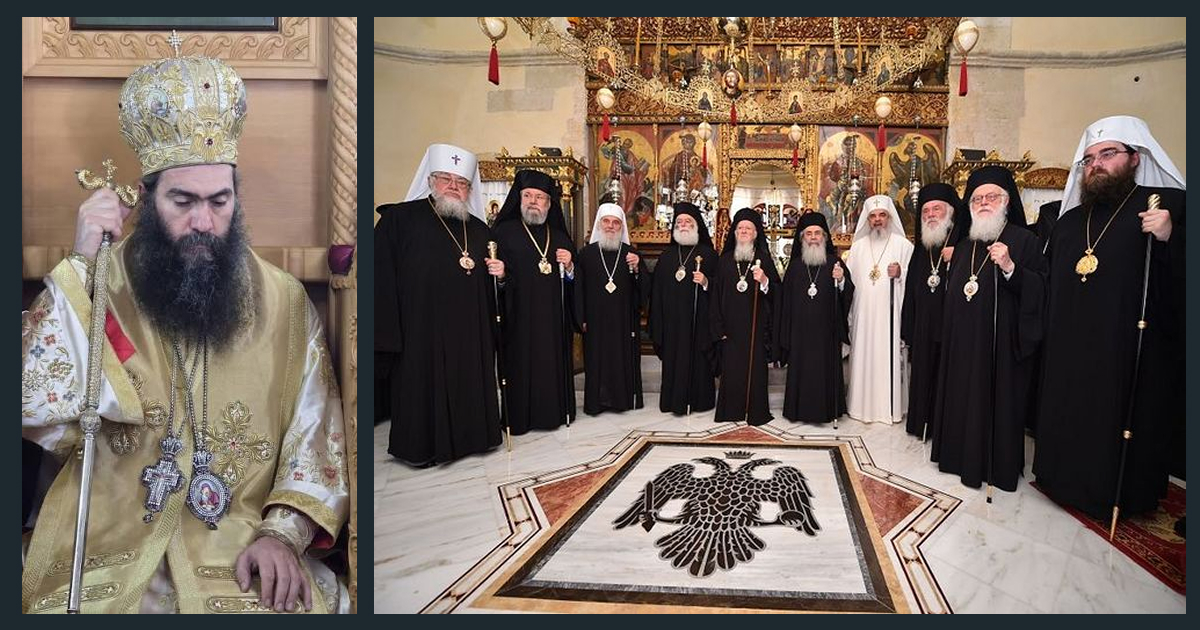
To His Eminence…
June 16, 2026
Your Eminence,
In May of 2025, the Holy Synod of the Orthodox Church of Cyprus required His Eminence Tychikos to sign a confession of faith[1] thereby accepting the so-called “Holy and Great Council of the Orthodox Church” held in Crete in 2016. This has raised among us a great question mark on the Orthodoxy of the Faith professed by the members of the Synod of our own Church.
The so-called “Holy and Great Council of the Orthodox Church” of Crete 2016 contains the official document entitled “Relations of the Orthodox Church with the Rest of the Christian World”[2], which ratified the Toronto Statement of 1950, entitled “The Church, the Churches and the World Council of Churches”[3]. The participation of the Local Orthodox Churches in the World Council of Churches, and the basis of dialogue with heretics, is undertaken upon acceptance of the heretical premises of this Statement which are considered of “paramount importance” in the aforementioned official document[4].
In these documents accepted by the Synod of the Orthodox Church of Cyprus[5], the dogma concerning the Church is altered, thus actually striking at the Niceno-Constantinopolitan Symbol of Faith. Even though the Symbol of Faith retains the words “One, Holy, Catholic and Apostolic Church,” the definition of the Church as a dogmatic term has been changed. Thus the Orthodox Church is no longer defined as the Only Body of Christ, nor is She any longer identified with the One Church of the Niceno-Constantinopolitan Symbol of Faith. This is evident from the deceitful and contradictory statements in the document “Relations of the Orthodox Church with the Rest of the Christian World,” but which appears with full clarity in the Toronto Statement of 1950.
In these two documents, the Church of Christ, or the One, Holy, Catholic and Apostolic Church, is understood as an invisible Universal Church (a mystical body)[6], which includes all Christian confessions which “believe in the Lord Jesus Christ as God and Savior in accordance with the Scriptures, and who confess the Triune God, Father, Son, and Holy Spirit, in accordance with the Nicene-Constantinopolitan Creed [Symbol of Faith]”[7]. Furthermore, Her unity has been lost, and must be restored, and She is a Church under construction which God is building and gathering His children together[8]. Thus the Orthodox Church is included in this invisible “Universal Church” together with other heretical groups, a point also highlighted by the quotation: “The member churches recognize that the membership of the Church of Christ is more inclusive than the membership of their own church body. […] All the Christian churches, including the Church of Rome, hold that there is no complete identity between the membership of the Church Universal and the membership of their own church. They [the Orthodox Church together with the heretics] recognize that there are church members “extra muros” [outside Her walls], and that these belong “aliquo modo” [in some way] to the Church, or even that there is an “ecclesia extra ecclesiam” [a Church outside the Church; that is to say: outside the Orthodox Church, there is the Church].”[9] It can be seen that the boundaries of the Church are being redefined[10]; there are no longer any heretics, nor are there any heresies. This stands in direct contradiction to Orthodox teaching, which holds that only the Orthodox Christians alone are members of the Church and that heretics are outside Her. Likewise Orthodox dogma proclaims that the Orthodox Church alone possesses the Truth, and that only She alone is the true Church, in contrast to what is affirmed in the Toronto Statement, namely, that “the churches [the Christian confessions] will be led into full truth,” and that “the member churches of the World Council recognize in other churches [that is, in heresies] elements of the true Church”[11] [the Church of Christ as confessed in the Symbol of Faith]. All these heresies stand condemned in the anathema proclaimed by the Synod of the Russian Orthodox Church Outside of Russia in August of 1983[12]. These deceitful phrases also demonstrate that in the encyclical[13] whereby the Synod of the Church of Cyprus accepted the pseudo-council of Kolymbari (Crete 2016), a lie is told when it is asserted that “the Orthodox Church remains the One, Holy, Catholic and Apostolic Church, and that She possesses and preserves the fullness of the Truth”[14]. This pseudo-council actually distorts the dogma concerning the Church, and spreads ecclesiological heresy within the Church.
According to Professor Dimitrios Tselengidis, Emeritus Professor of Dogmatics at the Faculty of Theology of the Aristotle University of Thessaloniki, the so-called “Holy and Great Council of the Orthodox Church” of Crete 2016 consolidated ecumenism institutionally, thereby introducing and promoting ecclesiological confusion in the minds of the faithful. Ecumenist thinking stands in contradiction to Orthodox Christian thinking and confession; that is to say, an ecumenist loses his status as an Orthodox Christian. Being an Orthodox Christian (in addition to receiving the Sacrament of Baptism and the other Holy Sacraments) also means accepting the entire teaching of the Church, including Orthodox ecclesiology, which affirms that only the Orthodox Church, and the Orthodox Church alone, is the One and Only, Holy, Catholic, and Apostolic, and that those outside of Her are heretics and deprived of salvation, and that, in order to be saved, they must unite with the Orthodox Church; otherwise, they remain outside of Christ. The ecclesiological heresies mentioned above, namely, the branch theory, the theory of the incomplete churches, and the theory of the invisible church, have been condemned as heresies both by the Fathers[15] and by Synods[16].
Your Eminence,
The Fifth Ecumenical Council, in its Eleventh Anathema, declares: “If anyone does not anathematise Arius, Eunomius, Macedonius, Apollinaris, Nestorius, Eutyches and Origen, as well as their impious writings, as also all other heretics already condemned and anathematised by the Holy Catholic and Apostolic Church, and by the aforesaid four Holy Synods and [if anyone does not equally anathematise] all those who have held and hold or who in their impiety persist in holding to the end the same opinion as those heretics just mentioned: let him be anathema.”[17]
Following the example of the Eleventh Anathema, which declares that whosoever refuses to anathematise heresies already anathematised by the Holy Councils is himself anathema, we, the Orthodox flock, would like to ask Your Eminence whether you are willing to anathematise, together with us, the heretical texts of the so-called “Holy and Great Council of the Orthodox Church” of Crete 2016.
The proclamation of this anathema will be the confession of Faith whereby we shall acknowledge Your Eminence as our Orthodox Shepherd, and shall participate in the holy services that You celebrate or in which You are commemorated by the Presbyters.
According to Saint Gregory Palamas, silence in the face of heresy is the third form of atheism[18]. We hope that You will respond to this letter and bear witness to Orthodoxy against ecclesiological heresy. Otherwise, Your Eminence’s silence will become the means by which heresy spreads within the Church, and You will place yourself outside the Church of Christ.
We desire to obey our bishops, but they must be guardians of our Faith. Otherwise, obeying shepherds who are indifferent, heretical, or atheist would mean our own departure from the Church of Christ.
We await Your Eminence’s reply!
We kiss Your right hand, and ask for Your holy prayers,
With all love in Christ,
Signed, the Orthodox faithful
[1] Synodal decision of 22 May 2025 of the Orthodox Church of Cyprus, https://cyprus-mail.com/2025/05/30/archbishop-expects-ousted-bishop-tychikos-to-sign-declaration-of-faith, accessed 1 June 2026
[2] Official document “Relations of the Orthodox Church with the Rest of the Christian World,” paragraph 19, https://www.holycouncil.org/rest-of-christian-world_el, accessed 1 June 2026
[3] Toronto Statement 1950, https://www.oikoumene.org/resources/documents/toronto-statement, accessed 1 June 2026
[4] Official document “Relations of the Orthodox Church with the Rest of the Christian World,” paragraph 19, https://www.holycouncil.org/rest-of-christian-world_el, accessed 1 June 2026
[5] Session of 18 July 2016, https://churchofcyprus.org.cy/23849, accessed 13 June 2026
[6] Toronto Statement 1950, IV. The Assumptions Underlying the World Council of Churches, Ecclesiological premise no. 3
[7] Official document “Relations of the Orthodox Church with the Rest of the Christian World,” paragraph 19, https://www.holycouncil.org/rest-of-christian-world_el, accessed 1 June 2026
[8] Toronto Statement 1950, Premise IV, paragraphs 5, 7, 8
[9] Ibid., IV. The Assumptions Underlying the World Council of Churches, Ecclesiological premise no. 3
[10] The document Relations of the Orthodox Church with the Rest of the Christian World, paragraph 19
[11] Toronto Statement 1950, IV. The Assumptions Underlying the World Council of Churches, Ecclesiological premise no. 5
[12] Synod of ROCOR, Vancouver, August 1983, held under the guidance of Saint Philaret (Voznesensky), “Those who attack the Church of Christ by teaching that Christ’s Church is divided into so-called “branches” which differ in doctrine and way of life, or that the Church does not exist visibly, but will be formed in the future when all “branches” or sects or denominations, and even religions will be united into one body; and who do not distinguish the priesthood and mysteries of the Church from those of the heretics, but say that the baptism and eucharist of heretics is effectual for salvation; therefore, to those who knowingly have communion with these aforementioned heretics or who advocate, disseminate, or defend their new heresy of Ecumenism under the pretext of brotherly love or the supposed unification of separated Christians, Anathema!”
[13] Encyclical “Message of the Holy Synod to the Whole Pleroma of the Most Holy Church of Cyprus,” 2016, https://churchofcyprus.org.cy/wp-content/uploads/2017/01/%CE%92%CE%99%CE%92%CE%9B%CE%99%CE%91%CE%A1%CE%99%CE%9F-%CE%99%CE%95%CE%A1%CE%91%CE%A3-%CE%A3%CE%A5%CE%9D%CE%9F%CE%94%CE%9F%CE%A5-.pdf
[14] Ibid., pp. 30–31
[15] Condemnation of ecumenism by theologians and Fathers of the Church:
[16] Pan-Orthodox synodal resolution against the “World Council of Churches”, Moscow, 1948, Ioniță, Fr. Prof. Dr. Viorel, Resolutions of the Pan-Orthodox Meetings from 1923 to 2009, pp. 151–154
Resolution of the Georgian Orthodox Church on Ecumenism, 8 October 1998, მიტროპოლიტი ანდრიას პასუხი პროტოპრესვიტერ გიორგი ცეცისს წერილზე: „სიმართლეა თუ „პროვოკაცია” საქართველოს ეკლესიის გადაწყვეტილება?”, accessed 15 Jul 2025
Synod of the Russian Orthodox Church Outside of Russia [ROCOR], August 1983, at the Synod in Vancouver, https://ortodoxiacatholica.com/blog/2024/08/21/the-official-anathema-of-rocor-against-ecumenism/?lang=en, accessed 15 Jan 2025
[17] Second Council of Constantinople (553), Anathema XI, in the Canons and Decrees of the Second Council of Constantinople, https://sourcebooks.fordham.edu/basis/const2.asp, accessed 13 June 2026
[18] Saint Gregory Palamas, “Letter to the most pious Monk Dionysios,” Saint Gregory Palamas — Complete Works, Vol. 4 [Αγίου Γρηγορίου του Παλαμά Άπαντα τα Έργα, Τόμος Δ’] (in Greek) (Thessaloniki: Paterikai Ekdoseis “Grigorios o Palamas,” 1983), p. 404
Biserica Ortodoxă este universală - Blog personal al Părintelui Matei Vulcanescu